Tag Archives: cello

Mystery of the Cello Position Naming System – Solved!

I had a big breakthrough this morning, and after 37 years of cello playing I think I finally understand the dubious logic behind the traditional / Suzuki cello position naming system.

Perhaps it makes sense to other cellists, but not one has been able to explain it to me adequately. Countless students of mine have asked me to explain the reason the positions are numbered as they are, and I’ve shrugged my shoulders. “It’s just how it is,” I’ve had to say.

Ever since studying cello with Laurien Laufman, I’ve used Janos Starker’s chromatic position naming system instead. I find it more sensible than the traditional / Suzuki one.

This biggest mystery with the traditional system has been the existence of “upper” and “lower” versions of some positions, and not others. What’s reason?

For years, my working theory has been that it’s based on the location of accidentals in the diatonic major scale. A Major is perhaps the basis, chosen because of the parallel between that scale and the beginning of the musical alphabet. My reasoning has been: in A major, the first three pitches are A, B and C sharp. C sharp creates an obvious duality with C natural — and therefore there are two possible second positions — the first “lower” second position starting on C natural, and the second “upper” second position starting on C sharp

The trouble was that I also found my working “diatonic major” theory flawed. It reasonably explains the existence of upper and lower second position but not upper and lower fourth position. Why should we consider putting the first finger on the pitch named enharmonically D sharp and E flat as lower fourth position? It could just as well be called upper third position, as neither D sharp nor E flat are in any of the diatonic major scales starting on an open cello string. And if it’s acceptable to have two names for one position, why is this not the case with with the lower positions?

Bang bang went my head into this problem. And then this morning I was sipping coffee and thinking about a beginning violin student in my middle school orchestra, I had the big “aha.”

The position naming system is most likely based on the violin hand and finger shape, which has been carelessly ported over to cello without much thought regarding applicability.

On the violin, the second finger is mobile — it covers two potential pitches. On the A string in first position, these are C sharp and C natural. The second finger has an “upper” and a “lower” position, and this is likely where the nomenclature “upper second position” and “lower second position” comes from!

What’s more, the violin fourth finger is also mobile, covering two possible pitches on the A string: E natural and E flat. Regardless of whether we consider this latter pitch enharmonically as an E flat or a D sharp, it is still played by the fourth finger. Hence the “upper” and “lower” fourth position nomenclature.

And just like that, mystery solved.

I guess it all makes sense on violin. But it’s more clear to me now why this naming system doesn’t make sense on cello — we use different fingerings! And I’m even more certain that Janos Starker’s chromatic-based system is a more sensible alternative.

Hope this helps you on your cello journey!

Varèse on his dream beyond the electric cello:

“Je rêve les instruments obéissants à la pensée” (I dream of musical instruments obedient to thought) — Edgar Varese in 391 Magazine, June 1917

Composer Edgar Varese also dreamt of resuming his collaboration with the cellist and inventor Lev Theremin, who had unfortunately become isolated behind the iron curtain in 1938. Varese complained to Theremin in a 1941 letter to Theremin (which he was sadly only able to finally read in 1989) that he had become disenchanted with all the “man-power (musical) instruments” and that the new electronic instruments remained inadequate.

Cellist Jonathan Golove describes Varese’s desire to use cello (fingerboard) theremin’s in his piece Equatorial here. Most human-electronic interfaces make use of the piano keyboard, and Theremin’s fingerboard interface was an exception.

The cello fingerboard too points beyond, toward the essence of music itself, which has no model in the physical world.

As Varese himself wrote in The Liberation of Sound, quoting Danish early Romantic poet Oehlenschlager:

“What seek you? Say! And what do you expect?
I know not what; the Unknown I would have!
What’s known to me is endless; I would go
Beyond the known: The last word still is wanting.”

Beginning String Ensemble Arrangement of Pachelbel Canon in D

Here’s an arrangement of Pachelbel’s Canon in D that I’ve been using with my elementary age students over the last couple years. Violin, viola and cello parts all get the theme, so it’s an “All-Inclusive” arrangement. My version is simplified to make it playable for everyone. The students clamor for the Canon in D, and learning and rehearsing it builds so many musical skills. Even my seventh and eighth graders who hate everything love to play it!


When Pachelbel wrote his beautiful Canon in D in 1680, he discriminated viciously against the cellists and violists in his local orchestra, scoring his masterpiece for 3 violins and basso continuo.

My All-Inclusive Theme from Canon in D reverses centuries of injustice, offering cellists and violists the world over the opportunity to join the violins as partners, getting their shot at Pachelbel’s timeless melody. 

I simplified and abridged the theme for beginning string players. Extended positions and shifting are almost entirely eliminated and meter is adjusted to simplify notation.

This a flexible arrangement, playable in a wide variety of formats: a single solo instrument with chording accompaniment, a duo in two-part canon, or a larger string ensemble in a multi-part canon. 

I’ve written continuo parts for every instrument — violin, viola, cello and bass. The burden of the infamously repetitive 8-bar basso continuo part is now available for everyone to shoulder. 

I recorded an example of the arrangement (mp3,) featuring two cellos in canon.

Downloads: 

Full Flexible Arrangement for String Ensemble (with cello demo Mp3) 

Arrangement for violins (with cello demo Mp3)

Arrangement for violas (with cello demo Mp3)

Arrangement for cellos (with cello demo Mp3) 

Mp3 Audio Recording 

JS Bach

Several students are currently learning Bach, so I’m sharing some all-time favorite recordings below.

Here is current CSO artist-in-residence Hilary Hahn back in 2007, performing a movement from Bach’s Sonata #2 in A minor for violin. Her ability to use double stops to bring out the multiple lines is amazing — at times it’s hard to believe only a single violinist is playing!

Hilary Hahn

Here is Leonard Bernstein with pianist Glenn Gould, performing Bach’s Keyboard Concerto #1 in D minor. Gould is able to bring Bach’s musical ideas to life on the piano, communicating their essence beautifully.

Glenn Gould / Leonard Bernstein

In this 1992 recording of the Prelude to Bach’s Cello Suite #1 in G Major, Dutch baroque cellist Anner Bylsma takes his time, reveling in the contours of Bach’s musical architecture. Bylsma’s baroque instrument resonates marvelously, recreating the pedal tone G in the opening bars that the organist composer surely had in mind.

Anner Bylsma

In this 1958 recording, violinists Yehudi Menuhin And David Oistrakh perform Bach’s Concerto for Two Violins:

Yehudi Menuhin, David Oistrakh

Here, early jazz musicians Django Reinhardt, Stephane Grappelli, and Chicago’s own Eddie South put their own spin on Bach’s Concerto for Two Violins in this “hot” recording:

Reinhardt, Grappelli, South

Cellist Yo-Yo Ma and vocalist Bobby McFerrin team up on the beautiful Air from Orchestral Suite #3, convincing us that Bach at the apex of the Baroque was master of both the old and the new. Bach seems to prefigure Chopin and Satie here as he tests the boundaries of G Major.

Yo-Yo Ma / Bobby McFerrin

Thinking about the rhythmic function of pizzicato in Nirvana’s Come As You Are

This was a tricky song to learn to sing and play at the same time. I probably first tried it on cello in 1995. I was able to apply a practicing breakthrough from my recent early jazz work to this song. The key is organizing the pizzicato rhythmically. Previously, I was using two fingers (1st and 2nd) to pizzicato “as it comes.” In other words the two right hand fingers simply alternate, regardless of the rhythmic function of the notes they are sounding. I learned however that it is better to assign the fingers a specific rhythmic function: 1st always plays downbeats, 2nd always plays weak beats, “on the and.” The change has helped with feel and rhythmic awareness when adding the syncopated vocal as sung by Kurt Cobain to a bassline.

Here’s a PDF for learning Come As You Are that includes a preparatory exercise to help organize the right hand pizzicato rhythmically.

https://payhip.com/b/brEpY

In Bloom / Nirvana – Cello Cover

First attempt at this Nirvana tune on cello was probably in 7th or 8th grade, in 1994. This week I used the concept of interval complements to come back to this song, making it much simpler by reducing shifting. Arranging the tune with interval complements also allows my left hand to move beyond root position power chords, eliminating cramping of first finger and wrist and general exhaustion of the hand

Bow Hold Video Series

I’ve been meaning to make bow hold videos for beginning cello students ever since I began taking remote students. These videos will work well for both remote students and as a technique builder for in-person students. Following along the videos with your dowel or pencil at home is a great way to warm up at the beginning of your regular daily practice session.

The first video in the series is Cello Bow Hold Video #1: Pre-Dowel Exercises. These exercises help students form a mental archetype of a relaxed, agile and balanced hand, prior even to work with a dowel or a pencil. Practice Notes for the first four videos in the series are available for download here.

Videos 2-4 are available here:

Cello Bow Hold Video #2: Dowel + Caveman Exercises

Cello Bow Hold Video #3: Dowel + Knee Bow Hold Exercises

Cello Bow Hold Video #4: Dowel + Knee Bow Hold + Cello

simple music worth noting

I found myself this evening dodging Chicago traffic on the way home and listening to an Eddie South recording from the late 1920s of By The Shores Of Lake Minnetonka, a popular tune from the era with Native American derivation. Chicago-based bandleader and violinist Eddie South was a child prodigy of classical violin who switched to performing jazz and popular music in the 1920s when racism foreclosed career options for him either with a major orchestra or on the solo circuit. South became arguably the strongest jazz violinist who has ever lived. In an era when it was not uncommon for violinists to front dance bands, South’s technique sparkles, outshining early jazz age violin contemporaries George Morrison, Erskine Tate, and Carroll Dickerson, and even second generation luminaries Joe Venuti and Stephane Grappelli.

While driving and listening, I was struck with the elegance of Eddie South’s performance on the recording. While South adorns the tune gracefully, the underlying musical idea is very simple.

It is a wonderful thing when a performer is able to reduce all possible complexity to its simple essence.

And not just great musicians, but all great artists, great thinkers, and great athletes possess this ability. They are able to take a wealth of experience and distill from it something very basic.

It is important it is to pay close attention to the seemingly simple, especially when offered by those with great experience.

A second example that came to mind as I was driving was composer JS Bach’s Two-Part Inventions, which contemporary jazz musician Jon Batiste recently pointed out in an interview were written for children. While hardly easy to play, they present a musical idea known as counterpoint in its most basic form. The big idea of counterpoint is that a single piece of music can be composed of two simultaneous voices that are mutually interdependent, without one being subordinate to the other. Simple — like a good human relationship.

Another image that flashed to mind was Einstein at the chalkboard, indicating his little formula E=MC2

In music, the simple ideas are often worth noting.

The ups and downs of jazz violin

There is a long history to the jazz violin. Chris Haigh’s website does a great job of documenting this lineage. Moreover, there are excellent contemporary jazz violinists. More interesting than thinking about this history in terms of a continuing linear evolution is considering the breaks and ruptures, and the roads not taken. On this latter note, there was a noticeable shift after the 1920s in which it seems that the (sometimes prominently featured) string quartets and (frequently prominently featured) violinists of hot jazz bands all but disappeared. By the time of big bands and the swing era in the 1930s, strings were no longer commonplace in popular jazz.

I think there were perhaps multiple factors that played into this transformation, and there are no simple reasons for the change. For example, a pat explanation is that big bands were simply too loud for violins and cellos. While at first glance this makes sense, it overlooks the important story of Eddie Lang, often credited with being the first jazz electric guitarist. The story with Lang is that he experimented in the early 20s with some of the first valve-based amplifiers made by RCA, using pickups made from hacked phonograph cartridges and telephone receivers. Already as early as 1917, the Russian scientist and cellist Lev Theremin had designed an electric cello, built by the early 20s, and presumably jazz string players experimented with methods of amplification just like guitarists.

Here are some related pictures:

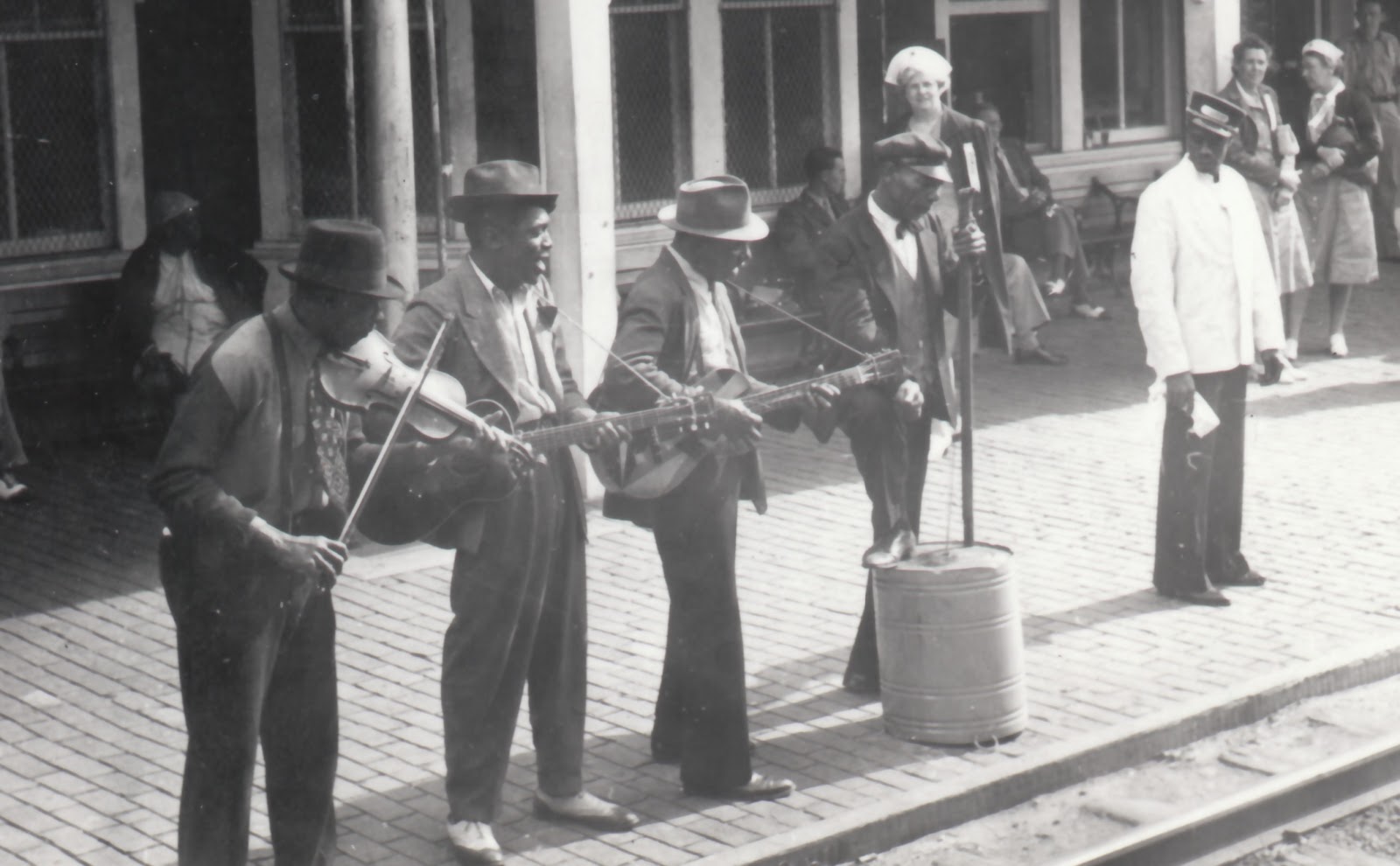
The violin has a long history in American folk music.

Buskers in the early 1930s

New Orleans band from early teens featuring acoustic guitar, violin, bass.

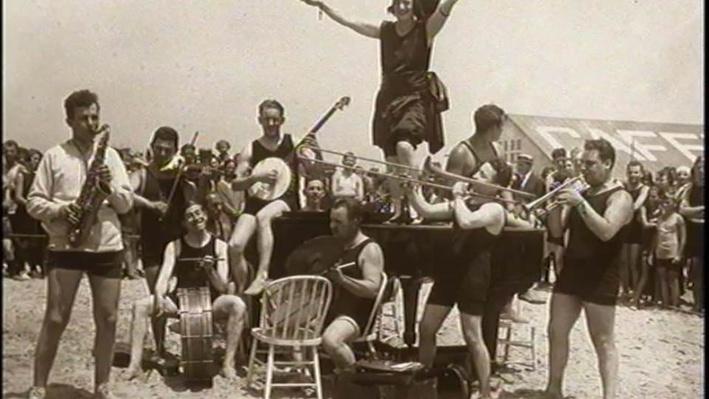
Jazz band from early 20s, violin left and rear

Early Creole jazz band from Ken Burns’ PBS jazz series

Proto Jazz

Library of Congress has a nice article on Ragtime that raises the fascinating topic of of polyrhythm as both African inspired but also found in the jigs and reels played by immigrants from the British Isles in the Appalachian regions of the US South. https://www.loc.gov/item/ihas.200035811

The wiki entry on Contradanze/Habanera is also a very interesting read, on the Afro-Cuban origins of proto-jazz styles. https://en.wikipedia.org/wiki/Contradanza

Another interesting musical form of proto jazz is the “Cakewalk”. Need to read more about this!