Mystery of the Cello Position Naming System – Solved!

I had a big breakthrough this morning, and after 37 years of cello playing I think I finally understand the dubious logic behind the traditional / Suzuki cello position naming system.

Perhaps it makes sense to other cellists, but not one has been able to explain it to me adequately. Countless students of mine have asked me to explain the reason the positions are numbered as they are, and I’ve shrugged my shoulders. “It’s just how it is,” I’ve had to say.

Ever since studying cello with Laurien Laufman, I’ve used Janos Starker’s chromatic position naming system instead. I find it more sensible than the traditional / Suzuki one.

This biggest mystery with the traditional system has been the existence of “upper” and “lower” versions of some positions, and not others. What’s reason?

For years, my working theory has been that it’s based on the location of accidentals in the diatonic major scale. A Major is perhaps the basis, chosen because of the parallel between that scale and the beginning of the musical alphabet. My reasoning has been: in A major, the first three pitches are A, B and C sharp. C sharp creates an obvious duality with C natural — and therefore there are two possible second positions — the first “lower” second position starting on C natural, and the second “upper” second position starting on C sharp

The trouble was that I also found my working “diatonic major” theory flawed. It reasonably explains the existence of upper and lower second position but not upper and lower fourth position. Why should we consider putting the first finger on the pitch named enharmonically D sharp and E flat as lower fourth position? It could just as well be called upper third position, as neither D sharp nor E flat are in any of the diatonic major scales starting on an open cello string. And if it’s acceptable to have two names for one position, why is this not the case with with the lower positions?

Bang bang went my head into this problem. And then this morning I was sipping coffee and thinking about a beginning violin student in my middle school orchestra, I had the big “aha.”

The position naming system is most likely based on the violin hand and finger shape, which has been carelessly ported over to cello without much thought regarding applicability.

On the violin, the second finger is mobile — it covers two potential pitches. On the A string in first position, these are C sharp and C natural. The second finger has an “upper” and a “lower” position, and this is likely where the nomenclature “upper second position” and “lower second position” comes from!

What’s more, the violin fourth finger is also mobile, covering two possible pitches on the A string: E natural and E flat. Regardless of whether we consider this latter pitch enharmonically as an E flat or a D sharp, it is still played by the fourth finger. Hence the “upper” and “lower” fourth position nomenclature.

And just like that, mystery solved.

I guess it all makes sense on violin. But it’s more clear to me now why this naming system doesn’t make sense on cello — we use different fingerings! And I’m even more certain that Janos Starker’s chromatic-based system is a more sensible alternative.

Hope this helps you on your cello journey!
Cellocentric Harmony: music theory on the cello fingerboard

The cello *should* be an ideal instrument on which to understand and deploy music theory concepts because of its regular tuning in perfect fifths (foundational for harmonic motion) and the cellists’ hand shape which spans a third (defining vertical structure in tertian harmony). In practice however, the cello fingerboard is frustratingly mysterious, and rarely intuitive. The Cellocentric Harmony project is my attempt to address this problem.

After learning and practicing the ideas in Cellocentric Harmony, I’m able to move around the fingerboard more intuitively while playing everything from classical to the blues. Hopefully others find this project helpful as well!

Classic Jazz for Strings – The Saints – A Multimodal and Multilevel course #learnjazz #learncello

Excited to finally release the first installment in my Classic Jazz for Strings course, The Saints: Level 1 for cello. It’s available as a multimodal course (including video guidance,) or you can download level 1 coursebook by itself.

Distilled from my work with cellists in Knights of Jazz String Band, this is the only course and method book that I know of for beginning cellists aspiring to play jazz.

Varèse on his dream beyond the electric cello:

“Je rêve les instruments obéissants à la pensée” (I dream of musical instruments obedient to thought) — Edgar Varese in 391 Magazine, June 1917

Composer Edgar Varese also dreamt of resuming his collaboration with the cellist and inventor Lev Theremin, who had unfortunately become isolated behind the iron curtain in 1938. Varese complained to Theremin in a 1941 letter to Theremin (which he was sadly only able to finally read in 1989) that he had become disenchanted with all the “man-power (musical) instruments” and that the new electronic instruments remained inadequate.

Cellist Jonathan Golove describes Varese’s desire to use cello (fingerboard) theremin’s in his piece Equatorial here. Most human-electronic interfaces make use of the piano keyboard, and Theremin’s fingerboard interface was an exception.

The cello fingerboard too points beyond, toward the essence of music itself, which has no model in the physical world.

As Varese himself wrote in The Liberation of Sound, quoting Danish early Romantic poet Oehlenschlager:

“What seek you? Say! And what do you expect?
I know not what; the Unknown I would have!
What’s known to me is endless; I would go
Beyond the known: The last word still is wanting.”

The Magic of the Cello: Ringtones

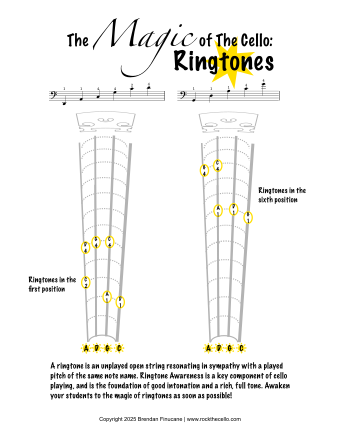
I’m kicking off a series of teaching/learning aids The Magic of the Cello for fellow cello teachers and cello students. The first is on ringtones.

A ringtone is an unplayed open string resonating in sympathy with a played pitch of the same note name. Ringtone Awareness is a key component of cello playing, and is the foundation of good intonation and a rich, full tone. Watch eyes light up as the strings vibrate as if by magic. Awaken your students to the magic of ringtones as soon as possible!

Full high quality pdf download


Beginning String Ensemble Arrangement of Pachelbel Canon in D

Here’s an arrangement of Pachelbel’s Canon in D that I’ve been using with my elementary age students over the last couple years. Violin, viola and cello parts all get the theme, so it’s an “All-Inclusive” arrangement. My version is simplified to make it playable for everyone. The students clamor for the Canon in D, and learning and rehearsing it builds so many musical skills. Even my seventh and eighth graders who hate everything love to play it!


When Pachelbel wrote his beautiful Canon in D in 1680, he discriminated viciously against the cellists and violists in his local orchestra, scoring his masterpiece for 3 violins and basso continuo.

My All-Inclusive Theme from Canon in D reverses centuries of injustice, offering cellists and violists the world over the opportunity to join the violins as partners, getting their shot at Pachelbel’s timeless melody. 

I simplified and abridged the theme for beginning string players. Extended positions and shifting are almost entirely eliminated and meter is adjusted to simplify notation.

This a flexible arrangement, playable in a wide variety of formats: a single solo instrument with chording accompaniment, a duo in two-part canon, or a larger string ensemble in a multi-part canon. 

I’ve written continuo parts for every instrument — violin, viola, cello and bass. The burden of the infamously repetitive 8-bar basso continuo part is now available for everyone to shoulder. 

I recorded an example of the arrangement (mp3,) featuring two cellos in canon.

Downloads: 

Full Flexible Arrangement for String Ensemble (with cello demo Mp3) 

Arrangement for violins (with cello demo Mp3)

Arrangement for violas (with cello demo Mp3)

Arrangement for cellos (with cello demo Mp3) 

Mp3 Audio Recording 

Easy cello duo and trio arrangements of Bach’s “Jesu, Joy Of Man’s Desiring”

If you teach cello students like I do, and use the Suzuki books, chances are many of your students get excited to play the Bach at the end of Book 1 and the beginning of Book 2.

Another good Bach option is Jesu, Joy Of Man’s Desiring, but If you’ve played an arrangement you’ll likely remember awkward shifts in G Major, overly-intricate rhythm notation, and a musical form out of reach for beginning students. I couldn’t find an arrangement out there without these problems, so I made my own. 

My duo and trio arrangements move Bach’s masterwork into C Major, the same key as his minuets in the Suzuki books. This does away with the awkward shifts, and showcases the cello’s most resonant key. I also simplified the form while retaining harmonic interest. 

The duo arrangement works great at a student recital, with a teacher accompanying on the second cello part. The trio arrangement is an excellent intro to chamber music for cello students.

Along with scores and parts, I’ve also included a series of Preparatory Exercises for students. These exercises isolate the C Major scale and all the diatonic arpeggios found in the piece. I’ve learned that students who first master the Preparatory Exercises prior to taking on the piece are much more successful! 

Finally, to aid home practice, I’ve included reference audio recordings (mp3 and wav) of the Preparatory Exercises, stems for each of the three cello parts separately, and the full trio.

Please share the download link for my arrangement with your students!

https://payhip.com/b/uy3Ll

Knights of Jazz String Band — Published Arrangements

Excited to finally finish editing and publish a collection of five early jazz classics for full flex string ensemble!

From the KJSB website:

Taking a cue from Suzuki pedagogy, our conviction is that great string teaching flows from great repertoire. Distilling five years of work with Knights of Jazz String Band, here are five early jazz favorites, presented as Early Jazz Classics For Strings, Volume 1. Arranged in an authentic “hot jazz” style, the meticulously edited parts are suited for Level 2.5 string players. Playable by any combo of string instruments, each tune in the collection is a “Full Flex Arrangement,” with melody, harmony and bass lines included for all instruments. The familiar melodies lend themselves to “melody-based improv,” — the best approach for beginning improvisors. Chord symbols are included so guitarists and pianists can easily jam along. History and lyrics for each tune provide context and enable deeper learning. “Beginning Bass Lines” on (mostly) open strings let beginning string players join in the fun!

The full collection:

Early Jazz Classics For Strings, Volume 1

Individual tunes:

The Saints

Jericho

Oh Susanna

Hava Nagila

Take Me Out To The Ball Game

JS Bach

Several students are currently learning Bach, so I’m sharing some all-time favorite recordings below.

Here is current CSO artist-in-residence Hilary Hahn back in 2007, performing a movement from Bach’s Sonata #2 in A minor for violin. Her ability to use double stops to bring out the multiple lines is amazing — at times it’s hard to believe only a single violinist is playing!

Hilary Hahn

Here is Leonard Bernstein with pianist Glenn Gould, performing Bach’s Keyboard Concerto #1 in D minor. Gould is able to bring Bach’s musical ideas to life on the piano, communicating their essence beautifully.

Glenn Gould / Leonard Bernstein

In this 1992 recording of the Prelude to Bach’s Cello Suite #1 in G Major, Dutch baroque cellist Anner Bylsma takes his time, reveling in the contours of Bach’s musical architecture. Bylsma’s baroque instrument resonates marvelously, recreating the pedal tone G in the opening bars that the organist composer surely had in mind.

Anner Bylsma

In this 1958 recording, violinists Yehudi Menuhin And David Oistrakh perform Bach’s Concerto for Two Violins:

Yehudi Menuhin, David Oistrakh

Here, early jazz musicians Django Reinhardt, Stephane Grappelli, and Chicago’s own Eddie South put their own spin on Bach’s Concerto for Two Violins in this “hot” recording:

Reinhardt, Grappelli, South

Cellist Yo-Yo Ma and vocalist Bobby McFerrin team up on the beautiful Air from Orchestral Suite #3, convincing us that Bach at the apex of the Baroque was master of both the old and the new. Bach seems to prefigure Chopin and Satie here as he tests the boundaries of G Major.

Yo-Yo Ma / Bobby McFerrin

Amplifying the cello: Part 1

I haven’t tried to amplify an acoustic cello since around 2007, when I sprung for a Yamaha SVC-210 electric cello. Prior to switching to the electric cello, I was frustrated in my efforts to amplify my acoustic cello using the Fishman C-100 piezo: thin sound, boomy and with a tendency to feedback in the midrange. I added the Fishman Platinum Pro-EQ to my gear bag and that helped a little, but I was still unsatisfied. I was flying internationally frequently with the cello in 2007, and the capability of the SVC-210 to fold and fit in the aircraft coat closet sealed the deal.

Today however, I regularly have cello students who are interested in amplifying their acoustic instruments. These students aren’t likely to invest 3k in an electric cello, and need something that sounds good at a reasonable price point.

Trying to give some guidance, I see that since I last looked in 2007 there are several new players in the cello amplification field. Realist, Feather, Headway, AKG, and Shure. There are piezos, contact microphones, gooseneck condensers, built-in bridge pickups, and a mysterious new strap-like technology called “The Band”. Prices range from $5 to about $650 for amplification solutions, and that’s not including the cost of an EQ or preamp. Most of the solutions fall within the $100 – $220 range.

I see several electric cellists on youtube have review/unboxing videos of particular pickups, but I don’t see a good overview of all the options. Is a $250 Realist pickup really (sorry) 50x better than a $5 one? If there are differences, how are these differences measured? Which sounds better, a contact mic, a gooseneck condensor, or a piezo? How do these different technologies work? How do different amplification goals (sheer volume vs. accuracy of sonic reproduction) map onto the different amplification options?

To answer some of these questions I’ll use a combination of my ears and the expertise of a professional. I’ll reach out to Farsheed who is an electric and acoustic engineer, working at Soapbox Music and Shure Microphones.

I’ll begin at the low-cost end of the spectrum, with a $5 clip-on microphone off Amazon, and see how it sounds through my Emperor 2×12 speaker cabinet.