Tag Archives: electric cello

Varèse on his dream beyond the electric cello:

“Je rêve les instruments obéissants à la pensée” (I dream of musical instruments obedient to thought) — Edgar Varese in 391 Magazine, June 1917

Composer Edgar Varese also dreamt of resuming his collaboration with the cellist and inventor Lev Theremin, who had unfortunately become isolated behind the iron curtain in 1938. Varese complained to Theremin in a 1941 letter to Theremin (which he was sadly only able to finally read in 1989) that he had become disenchanted with all the “man-power (musical) instruments” and that the new electronic instruments remained inadequate.

Cellist Jonathan Golove describes Varese’s desire to use cello (fingerboard) theremin’s in his piece Equatorial here. Most human-electronic interfaces make use of the piano keyboard, and Theremin’s fingerboard interface was an exception.

The cello fingerboard too points beyond, toward the essence of music itself, which has no model in the physical world.

As Varese himself wrote in The Liberation of Sound, quoting Danish early Romantic poet Oehlenschlager:

“What seek you? Say! And what do you expect?
I know not what; the Unknown I would have!
What’s known to me is endless; I would go
Beyond the known: The last word still is wanting.”

The ups and downs of jazz violin

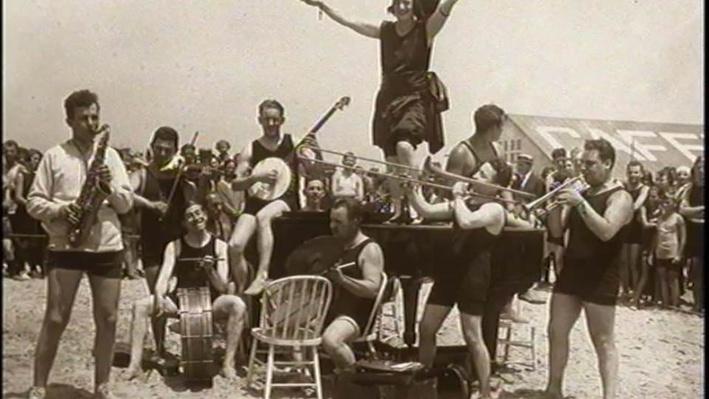
There is a long history to the jazz violin. Chris Haigh’s website does a great job of documenting this lineage. Moreover, there are excellent contemporary jazz violinists. More interesting than thinking about this history in terms of a continuing linear evolution is considering the breaks and ruptures, and the roads not taken. On this latter note, there was a noticeable shift after the 1920s in which it seems that the (sometimes prominently featured) string quartets and (frequently prominently featured) violinists of hot jazz bands all but disappeared. By the time of big bands and the swing era in the 1930s, strings were no longer commonplace in popular jazz.

I think there were perhaps multiple factors that played into this transformation, and there are no simple reasons for the change. For example, a pat explanation is that big bands were simply too loud for violins and cellos. While at first glance this makes sense, it overlooks the important story of Eddie Lang, often credited with being the first jazz electric guitarist. The story with Lang is that he experimented in the early 20s with some of the first valve-based amplifiers made by RCA, using pickups made from hacked phonograph cartridges and telephone receivers. Already as early as 1917, the Russian scientist and cellist Lev Theremin had designed an electric cello, built by the early 20s, and presumably jazz string players experimented with methods of amplification just like guitarists.

Here are some related pictures:

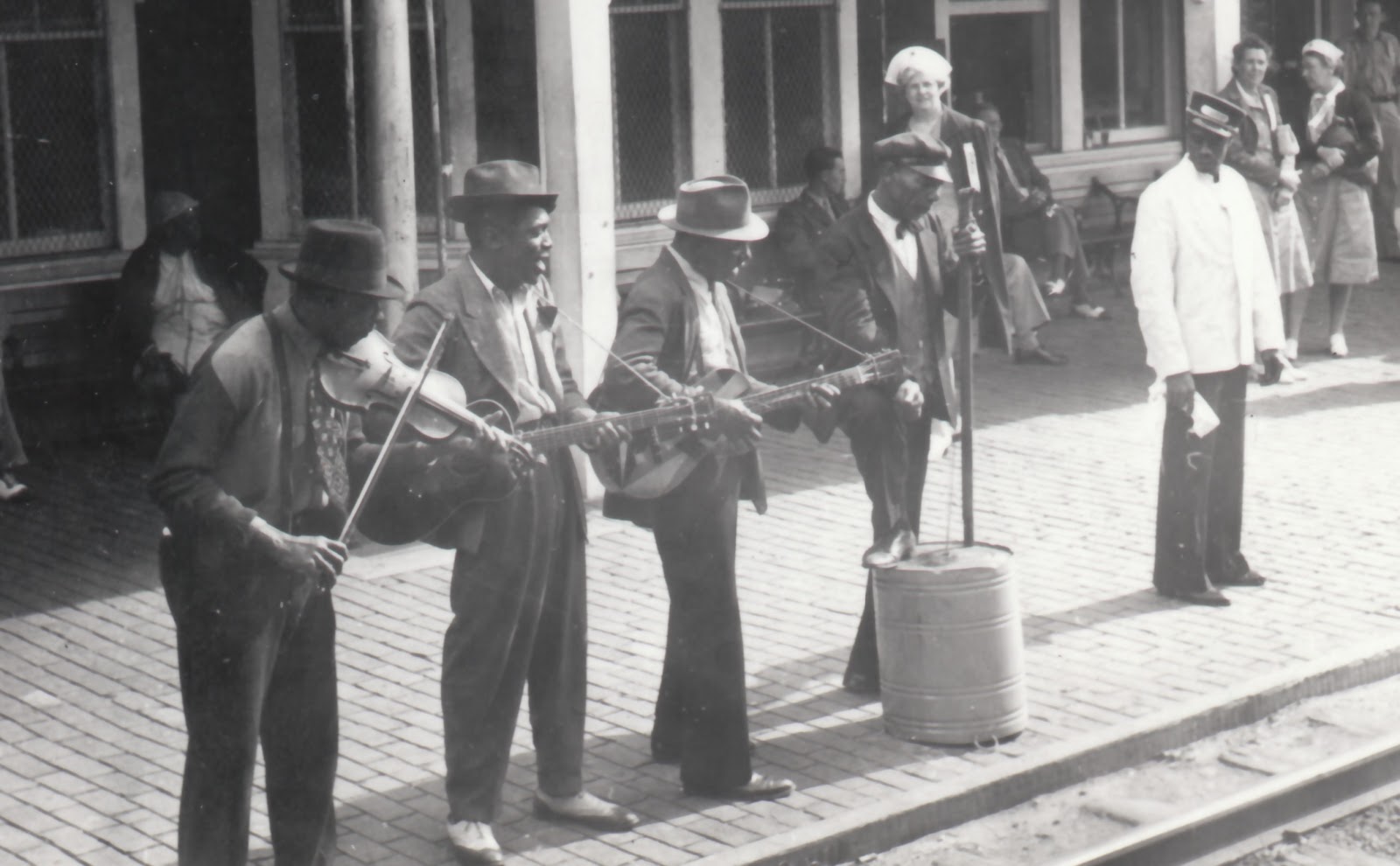
The violin has a long history in American folk music.

Buskers in the early 1930s

New Orleans band from early teens featuring acoustic guitar, violin, bass.

Jazz band from early 20s, violin left and rear

Early Creole jazz band from Ken Burns’ PBS jazz series